
Scott County Criminal Court Records
A criminal court record is the case-level file that the court maintains once the matter is opened. In Scott County, the Office of Circuit Court Clerk manages the local Circuit, Family, and District Court records for the Kentucky Court of Justice. A criminal case file may include a citation, complaint, warrant, indictment, information, bond order, docket entries, motions, plea form, disposition, sentence, probation terms, fines, court costs, restitution, and appeal activity. It may also show when a charge was amended, reduced, dismissed, or resolved by plea or trial.
Court level matters. Scott County Circuit Court handles felonies and capital offenses. District Court handles misdemeanors, violations, traffic offenses, arraignments, and felony probable-cause hearings. A felony may start in District Court for the first appearance, then move to Circuit Court after indictment or other charging action. That movement can leave docket entries at more than one court level, while the local Circuit Court Clerk remains the practical records contact.
The full criminal case file is not the same as the narrower charge-focused path described in Scott County arrest records and court charges. A charge page helps explain the accusation and charging document. A criminal court record page follows the case through plea, trial, disposition, and sentence.
Search Scott County Criminal Court Records
Use KYeCourts Public Court Records guest access for public case-information lookup. The guest screen requires a public-records acknowledgement checkbox and Continue before search. If the defendant's case number is known, use it. If not, search by name and narrow to Scott County or the correct court when the system allows. Because the portal is statewide, broad names can return cases from outside Scott County.
- Open KYeCourts guest access from the Kentucky Court of Justice case-search path.
- Check the public-records acknowledgement box and continue into the public search.
- Search by defendant name, case number, or citation number if the case began as a citation.
- Review the docket for arraignment, bond, motions, plea, disposition, sentence, and appeal activity.
- Contact the Scott County Circuit Court Clerk for certified copies, older files, or documents not shown online.
When the goal is a formal statewide criminal history, use the Kentucky Administrative Office of the Courts record-report channel rather than assuming a case search is a complete background report. The AOC criminal record report page is a separate path from a case docket or certified court-file request.
Scott County Criminal Case Flow
Criminal court records are easiest to read in case-flow order. A case may begin with an arrest, citation, complaint, indictment, or information. District Court may handle the first appearance and probable-cause steps in felony matters, while Circuit Court handles the felony case after it moves forward. Misdemeanor and traffic matters often remain in District Court. Each step creates a docket entry or document that can affect the next event.
Case flow: Charges Filed › Arraignment › Pretrial / Motions › Plea or Trial › Disposition › Sentencing
| Stage | What Happens |
|---|---|
| Charges filed | A citation, complaint, information, or indictment states the criminal accusation and starts or advances the court case. |
| Arraignment | The defendant appears, the charge is addressed, bond may be reviewed, and a plea may be entered. |
| Pretrial and motions | The parties file requests, exchange information, set hearings, continue dates, and address suppression or evidentiary issues. |
| Plea or trial | The case resolves by plea, dismissal, trial verdict, or another court-approved disposition. |
| Disposition | The record shows the result of each charge, such as guilty, not guilty, dismissed, amended, or diverted. |
| Sentencing | The court imposes jail, prison, probation, fines, costs, restitution, conditions, or other sentence terms when applicable. |
What Scott County Criminal Records Show
A Scott County criminal court record may show more than one charge and more than one outcome. One arrest or complaint can lead to several counts. Some counts may be amended or dismissed while another count ends in a guilty plea. A docket may also show bond changes, failure-to-appear activity, bench warrants, payment plans, probation terms, and restitution orders. Online public access may show summary data, while full documents may require a clerk request.
| Field | What It Shows |
|---|---|
| Case number | The Kentucky court identifier used for search, docket review, and copy requests. |
| Defendant | The person charged in the criminal case, with identifying data limited or redacted where required. |
| Court and division | Whether the case is in Scott County District Court, Circuit Court, or a listed division. |
| Charges | The alleged offenses, charge level, statute or code reference if shown, and count information. |
| Bond | Release terms, cash or surety conditions, warrant-related changes, or custody-related entries when public. |
| Docket entries | Arraignment, motion, pretrial, plea, trial, disposition, sentence, continuance, or appeal activity. |
| Disposition | The outcome of each charge, such as dismissed, guilty, amended, diverted, or acquitted. |
| Sentence | Jail or prison time, probation, fines, costs, restitution, and other court-ordered conditions. |
The Kentucky Attorney General county-attorney directory identifies the Scott County Attorney's public office contact, which matters because Kentucky uses County Attorneys and Commonwealth's Attorneys rather than the title District Attorney.
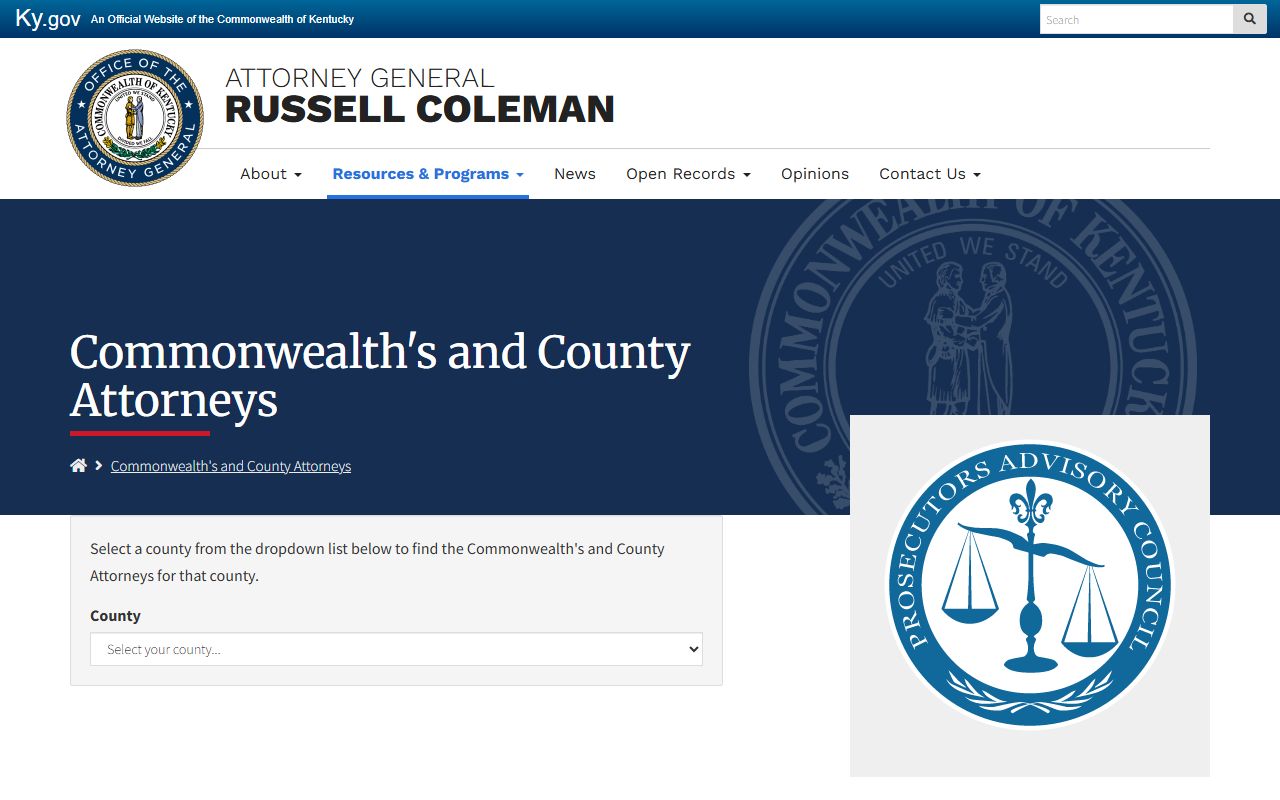
The county-attorney source helps distinguish prosecution offices from the court clerk, since charging decisions and court-file custody are not the same function.
Scott County Criminal Prosecution Offices
Kentucky does not use a District Attorney title for Scott County criminal cases. The Scott County Attorney handles misdemeanor, traffic, juvenile, child-support, and county-level prosecution functions. The official office site identifies Cam Culbertson as Scott County Attorney, and the Attorney General directory lists the office at 198 East Washington Street in Georgetown with phone 502-863-7870. Felony prosecutions are handled by Commonwealth's Attorneys. Scott County is in the 14th Judicial Circuit, so felony charging and prosecution may involve that circuit's Commonwealth's Attorney while the case record remains with the Circuit Court Clerk.
The Scott County Attorney team page is the local source for the county-level prosecution office and staff context.

The County Attorney source is relevant to misdemeanor, traffic, juvenile, and local prosecution context, but copies of criminal court records still come from court-record channels.
Scott County Charges vs Convictions
A charge is an accusation. A conviction is a formal guilty outcome by plea or verdict. The Scott County Detention Center inmate lookup page makes the same key point in the custody context: criminal charges should not be confused with convictions. Criminal court records may show charges that were later dismissed, amended, reduced, or resolved without a conviction. Read each count separately.
| Point | Charge | Conviction |
|---|---|---|
| Meaning | An accusation filed with the court or stated in a charging document. | A guilty plea, guilty verdict, or other formal guilty finding. |
| Case stage | Early or pending stage, subject to amendment or dismissal. | Final or resolved stage for that count, subject to appeal or later relief. |
| Record reading | Look for current status and whether the count changed. | Look for sentence, probation, fines, costs, and restitution. |
| Risk of error | Easy to overstate if read without disposition. | Still requires checking expungement, appeal, and sentence status. |
Read Scott County Dispositions
Disposition language tells what happened to each charge or case. Guilty means a guilty plea or finding was entered. Not guilty may reflect a verdict or plea context, so read the docket sequence. Dismissed means the charge or claim ended, but the reason may matter. Amended means the charge changed. Diverted means the case followed a diversion path under court-approved terms. Probation means a sentence is served under supervision instead of, or after, incarceration.
Sentencing entries may show jail time, prison time, probation, conditional discharge, fines, costs, restitution, treatment conditions, no-contact orders, payment plans, or credit for time served. If the public docket uses a short label, ask the clerk for the official order or judgment before relying on it for a legal deadline, employment purpose, housing decision, licensing issue, or court filing.
Note: A Scott County criminal docket can show several charges with different outcomes in the same case.
Scott County Sealed vs Expunged Records
Sealed and expunged records are not ordinary public lookup records. A sealed record is blocked from public access by law or court order, but it may still exist for limited official access. Expungement is stronger in the criminal-record context. KRS 431.079 defines expungement for Kentucky criminal-record statutes as removal or deletion so the matter does not appear on official state-performed background checks. KRS 431.073 provides a pathway for certain felony convictions to be vacated and expunged, subject to statutory limits and fees.
| Point | Sealed | Expunged |
|---|---|---|
| Public visibility | Hidden from ordinary public access. | Removed or deleted from public criminal-record reporting as allowed by court order. |
| Common basis | Confidential case type, court order, juvenile rule, protected data, or sealed filing. | Eligibility under Kentucky expungement statutes and court process. |
| Record handling | May still exist with restricted official access. | Treated under the expungement order and not reported as an active public matter. |
| Public search result | May show no detail or no case result. | Should not be treated as an available public charge after completion. |
Public Access to Scott County Criminal Records
Public access starts with the Kentucky Court of Justice case-search and records-request paths. KRS 61.872 generally supports inspection of public records by Kentucky residents unless an exception applies, while KRS 61.878 and KRS 61.874 address exemptions, copying, fees, and commercial-purpose rules. Criminal cases may be public in summary form, but public access does not erase restrictions for juveniles, sealed records, expunged records, protected identifiers, victim-sensitive data, medical information, or records withheld by law.
Key access rule: KYeCourts is useful for public case information, but certified Scott County criminal record copies come from the court clerk.
County open-records forms should not be substituted for court-file requests. Scott County government records, Georgetown city records, jail records, and court case files each follow the agency path that controls the record. If the criminal file is stored off site, the local clerk must provide case and file locator numbers before the State Records Center can act.
Scott County Background Check Limits
A public criminal court record lookup is not the same as a consumer background report. AOC criminal record reports are a formal Kentucky channel, while KYeCourts case lookup gives public case information. Employment, housing, credit, insurance, and other regulated screening uses have legal rules that are separate from casual court-record research. Always verify the case, identity, disposition, and expungement status with official sources before drawing a conclusion from a name match.
Public defense information is also separate from the case record. The Kentucky Department of Public Advocacy Georgetown Trial Office serves Bourbon, Scott, and Woodford counties. Its statewide mission is to represent indigent persons accused of crimes or facing deprivation of liberty. That office may appear in a criminal case as counsel, but it does not serve as the public records office for the court file.
Restricted Scott County Criminal Records
Juvenile criminal and juvenile court records are restricted under KRS 610.320 and KRS 610.340. Access may be limited to the child, family, guardian or legal representative, courts, prosecutors, probation, the Department of Juvenile Justice, law enforcement, victims in defined circumstances, and schools only when statutes allow. Adoption, mental-health, medical, minor-identifying, protected-address, and sealed materials are also outside ordinary public access.
For active or sensitive criminal matters, public details may be limited to protect investigations, victims, minors, or sealed court orders. If a public search does not return a case that should exist, possible reasons include spelling, wrong court level, off-site storage, sealing, expungement, juvenile status, or a nonpublic record category. The safest next step is to call or visit the Scott County Circuit Court Clerk with as much case detail as possible.